Signed in as:
filler@godaddy.com
Signed in as:
filler@godaddy.com
ACA stands for the Affordable Care Act, which is a comprehensive healthcare reform law enacted in the United States in 2010. The ACA, also known as Obamacare, was implemented to increase access to affordable healthcare coverage, improve the quality of healthcare, and reduce healthcare costs.
ACA creates huge compliance problems for employers over 50 employees. The requirement of applicable large employers (ALE) is daunting and carries penalties up to $7,250 per employee per year for 2025. Critical steps include filing annually the form 1094 / 1095 with appropriate IRS tax submission on a strict timeline.
The ACA has had a significant impact on the healthcare landscape in the United States, expanding access to coverage for millions of Americans. However, it has also been a subject of political debate and has faced various changes and legal challenges since its implementation.
Why is it important to consult with tax professional such as ESG regarding ACA laws is important for several reasons:
Given the evolving nature of ACA regulations and the potential consequences of non-compliance, consulting a tax professional with expertise in ACA laws can help employers navigate the complexities, reduce risks, and ensure compliance with the applicable provisions.
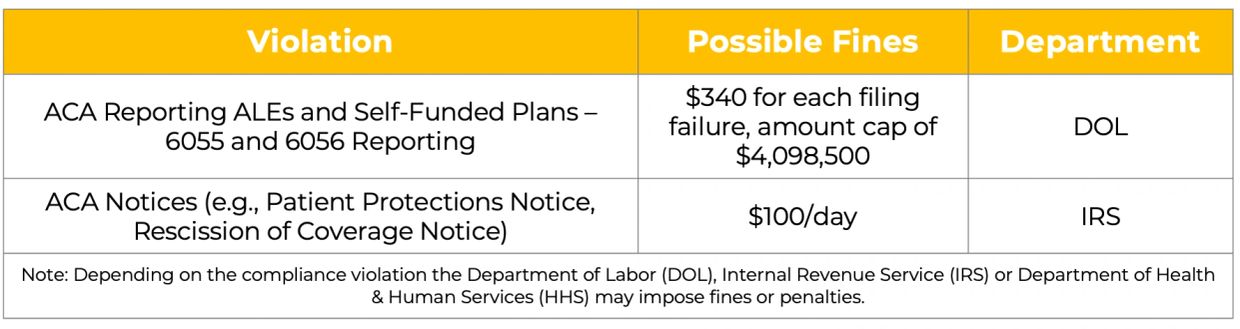
As an ALE, understanding the regulations set forth by the Affordable Care Act (ACA) can feel complex, but understanding the basics is essential to staying compliant and avoiding costly penalties. The employer mandate, minimum essential coverage (MEC), minimum value and affordability requirements are
An ALE, or Applicable Large Employer, is any company or organization that employs at least 50 full-time equivalent (FTE) employees on average during the prior calendar year. The IRS defines a full-time employee as someone who works 30 or more hours per week or 130 hours per calendar month. This includes all paid hours such as PTO and certain types of leave. Even if a company doesn’t have 50 full-time employees at all times, it only needs to average that number over the year to qualify as an ALE for the following year.
The Employer Mandate, also known as the Employer Shared Responsibility Provisions (ESRP), applies only to ALEs. Under this rule, ALEs must:
These requirements apply only to full-time employees for penalty purposes, not FTEs. Additionally, the first 30 full-time employees are excluded when calculating the penalty under Section 4980H(a).
MEC is the baseline level of coverage defined under the ACA. Plans that meet MEC include:
To avoid penalties under Section 4980H(a), ALEs must offer MEC to at least 95 percent of their full-time employees and dependents.
To meet Minimum Value, a plan must cover at least 60 percent of total allowed benefits costs and include substantial inpatient and physician services. This standard is what protects ALEs from the Section 4980H(b) penalty.
There are two types of penalties under Internal Revenue Code Section 4980H:
If at least one employee receives a federal subsidy, such as a premium tax credit on the Marketplace, and the employer failed one of the tests above, the IRS will assess the higher of the two penalties. Both penalties cannot be applied at the same time.
The IRS adjusts penalties each year. For 2025, the estimated amounts are:
Penalties apply monthly and are based on the number of months the employer was not in compliance.

Copyright © 2026 Employee Solutions Group - All Rights Reserved.
We use cookies to analyze website traffic and optimize your website experience. By accepting our use of cookies, your data will be aggregated with all other user data.